
1. Strategic Overview: The Shift in Global RX & Cosmetic Lens Procurement
The global contact lens market is undergoing a structural transformation driven by converging consumer desires: vision correction (RX), aesthetic enhanced pupil definition, and medical-grade corneal hydration. B2B optical buyers, regional retail brands, and e-commerce enterprise distributors can no longer rely on standardized, off-the-shelf catalog lenses. To maintain market share, sourcing directors require custom OEM (Original Equipment Manufacturer) and ODM (Original Design Manufacturer) partnerships that bridge high-index optical clarity with advanced biomechanical compatibility.
As a leading custom OEM wholesale RX lenses factory & supplier, Stephies Lens CO.,LTD operates at the intersection of precision polymer engineering and high-fashion cosmetic optics. Our manufacturing infrastructure is tailored specifically to eliminate supply chain friction for B2B procurement heads, providing full traceability from monomer polymerization to sterile blister packaging.
Information Gain Key Insight: The modern prescription (RX) cosmetic lens market demands dual-performance hydrogel matrices: high oxygen transmissibility (Dk/t) combined with encapsulated 3-layer micro-pigmentation that prevents direct pigment-to-cornea contact while maintaining true spherical refractive power (-0.50D to -10.00D).
2. Engineering Excellence: OEM/ODM Manufacturing Capabilities
Precision vision correction demands sub-micron manufacturing tolerances. A variation of even 0.02mm in central lens thickness can alter prescription power or impair tears exchange beneath the lens body. Stephies Lens integrates state-of-the-art cast-molding and precision lathe-cutting technologies to produce consistent optical geometries.
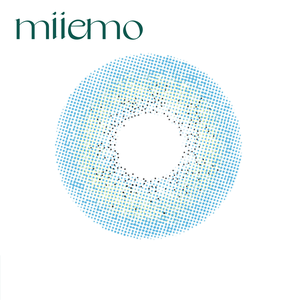
3-Layer Color Lock Tech
Pigments are embedded between inner and outer bio-compatible polymer coatings, guaranteeing zero direct color contact with corneal endothelial cells.
High Dk/t Permeability
Utilizing high-grade HEMA and advanced Silicone Hydrogel polymers, our lenses maintain high tear transport and corneal oxygen flow for daily and extended wear safety.
Precision Lathe & Mold Optics
Advanced computer-controlled cast molding ensures identical base curves (8.5mm to 8.6mm) and focal uniformity across millions of mass-produced units.
Technical Material Specifications Matrix
When selecting your custom OEM RX lens series, optical physical metrics dictate wearer comfort, regulatory compliance, and market viability. Below is our standard manufacturing reference framework:
- Base Polymer Options: Poly-HEMA (Hydroxyethyl Methacrylate), Non-Ionic Hydrogel, and Advanced Silicone Hydrogel.
- Water Content Range: 38% (Optimized for low tear-evaporation and dry eye environments) to 55% (High initial hydration).
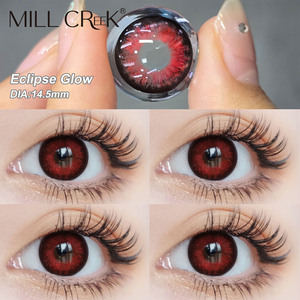
- Diameter Envelope: 14.0mm to 14.5mm for natural cosmetic & RX corrective wear; 17.0mm (Mini Sclera) and 22.0mm (Full Sclera) for theatrical SFX lines.
- Prescription Range (RX): Plano (0.00D) up to -10.00D (Myopia) with incremental steps of 0.25D or 0.50D. Toric (Astigmatism) designs available upon custom contract engineering.
- UV Filter Integration: Class 2 UV blocking absorbing >70% UVA and >95% UVB rays embedded directly into the lens polymer.
3. Industry Trends: Future Procurement Dynamics in Wholesale RX & Cosmetic Lenses
Procurement directors navigating the 2026–2030 commercial landscape must adapt to three major macro-industry developments shaping consumer purchasing behaviors:
A. Hybrid Functional Aesthetics (Rx + Natural Beauty)
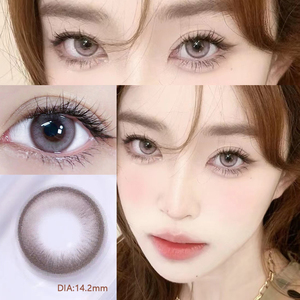
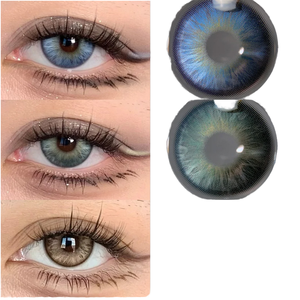
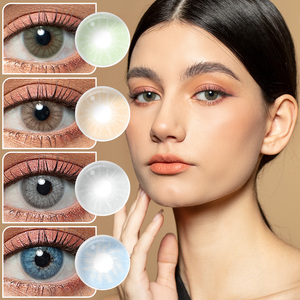
The boundary between purely vision-corrective clear contact lenses and purely cosmetic colored lenses has vanished. Today's demographic requires subtle, hyper-realistic iris embellishment (such as hazel, honey, olive, and translucent grey tones) backed by exact optical prescription powers. Brands expanding their catalog must offer unified stock-keeping units (SKUs) featuring both plano and RX variants within identical color options.
B. Shift Toward Short-Term Disposable Modalities
While yearly replacement lenses remain cost-effective in specific global regional channels, daily disposable and monthly replacement modalities are experiencing compound annual growth rates (CAGR) exceeding 11.2%. OEM brand buyers are increasingly ordering localized private-label blister packaging designed for daily disposal, minimizing eye contamination risk and elevating recurring lifetime value (LTV) per customer.
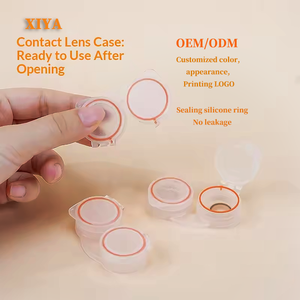
C. Eco-Friendly & Automated Private Label Packaging
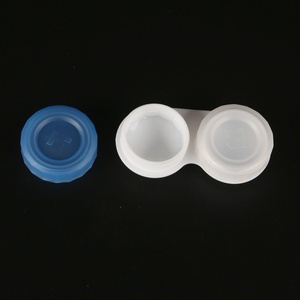
Global regulatory bodies and environmentally conscious consumers are placing greater focus on recyclable blister foil substrates, minimized secondary paperboard packaging, and sustainable lens accessory companions. Stephies Lens offers customized PP-02 plastic companion boxes and ergonomic double-box solutions that align with zero-waste retailer initiatives.