0%

Sourcing Natural Colored Contact Lenses Wholesale in 2026 requires more than comparing prices. Buyers must examine product safety, supplier reliability, color consistency, and market-specific compliance. A lens may look beautiful in a sample photo, yet feel uncomfortable after several hours. That gap can damage customer trust and increase returns.

Experienced buyers usually begin with a documented supplier review. Check manufacturing experience, quality certifications, batch traceability, and testing records. Ask how pigments are contained within the lens material. Request samples from different production batches. Compare their diameter, base curve, moisture performance, packaging, and printed color under natural light. Small differences matter.

Compliance cannot be treated as a final checklist. Contact lenses may be regulated medical devices, depending on the destination market. Confirm applicable registration, labeling, prescription, import, and advertising requirements before placing an order. Work with qualified regulatory advisers when needed. Never rely on a supplier’s promise alone.

Price still matters.

However, the lowest quotation may hide weak quality controls, unstable lead times, or poor after-sales support. A practical wholesale plan should calculate the complete landed cost, including inspection, freight, customs, rejected units, and replacement stock. Build clear agreements for defects and delivery delays. Keep written records.

No sourcing plan is flawless. Some buyers overestimate trend forecasts or underestimate packaging rules. That mistake is avoidable, but not always obvious. This guide explains how to evaluate Natural Colored Contact Lenses Wholesale suppliers with stronger evidence, careful sampling, and responsible purchasing decisions for 2026.
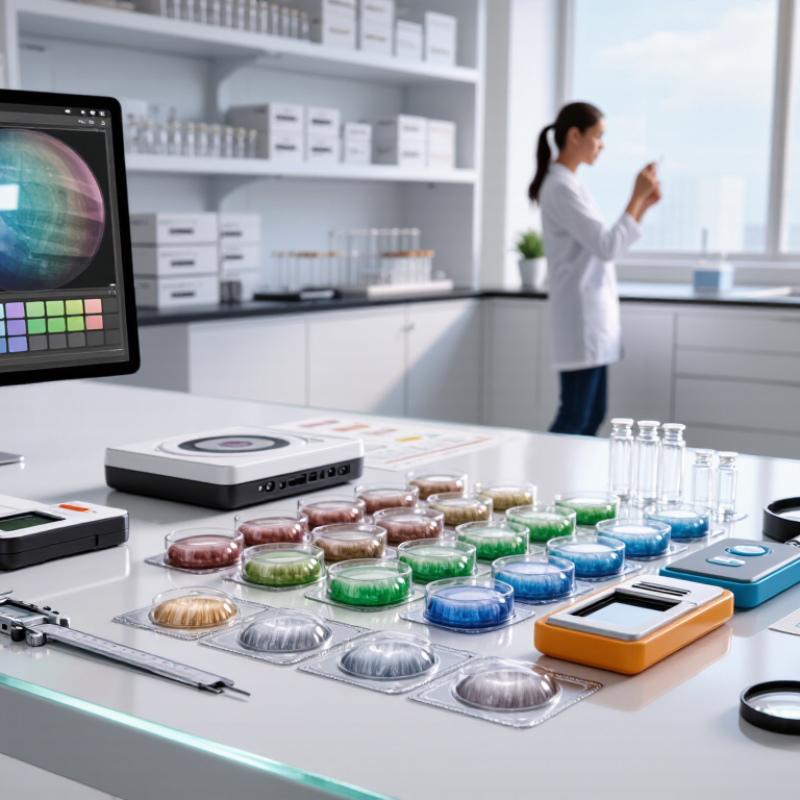
How to Source Natural Colored Lenses Wholesale in 2026?

Define Natural-Look Specs Using Diameter, Base Curve, and Water Content

In 2026, sourcing natural colored lenses wholesale requires more than choosing a soft, believable shade. The lens dimensions shape the entire visual effect. Diameter controls how much of the iris appears enlarged. A 14.0 mm lens may look subtle, while a 14.5 mm option creates a more noticeable edge. The graphic diameter matters too. A wide printed area can appear dramatic, even when the overall lens diameter seems modest.

Base curve affects movement and comfort. Common curves may include 8.6 mm or 8.8 mm, but neither suits every eye. A responsible supplier should provide fitting guidance, manufacturing tolerances, and sample lenses for professional evaluation. Water content also deserves careful attention. Higher water content can feel comfortable initially, yet some wearers may experience dryness during long hours. Lower water content may retain moisture better for certain users, but comfort still depends on material and fit. It is not a simple ranking.

Ask wholesalers for complete specifications, batch records, quality testing, and clear instructions for permitted use in each target market. Check whether the lens centers correctly after blinking and whether the color remains natural in daylight, office lighting, and close photographs. I have found that printed patterns often look softer on a sample card than on the eye. That mistake is easy to make. Recheck the limbal ring, opacity, and edge blending before placing a large order. A polished wholesale process should also include traceability, hygienic packaging, and support from qualified eye-care professionals. Safety cannot be judged by appearance alone.

Use CDC’s 45 Million U.S. Wearers to Size the 2026 Market

How to Source Natural Colored Lenses Wholesale in 2026?

The CDC estimates that about 45 million people in the United States wear contact lenses. This figure offers a useful 2026 market baseline, but it is not a colored-lens sales forecast. Many wearers choose clear lenses, occasional cosmetic options, or no color change at all. Treat the estimate as a ceiling, not a promise. Natural shades may still attract buyers seeking soft brown, honey, gray, or green effects for daily styling.

Wholesale sourcing should begin with product safety and documented quality. Ask suppliers for prescription details, material specifications, base curve, diameter, oxygen permeability, batch records, and expiration information. Request samples from different production lots. Check whether the color remains even after cleaning and wearing. Packaging should show traceable information and clear usage instructions. For the U.S. market, confirm applicable regulatory status and sell only through lawful, qualified channels. Do not assume attractive packaging proves reliability.

Tips: Build demand estimates by age, shade preference, repeat purchase rate, and seasonal demand. Compare small sample orders before negotiating volume prices. Keep a written inspection checklist. Also, question your own forecast. The 45 million figure is powerful, but it includes users who may never buy colored lenses. A modest test may reveal more than an impressive spreadsheet. Safety and fit should guide every purchasing decision.

How to Source Natural Colored Lenses Wholesale in 2026? - Use CDC’s 45 Million U.S. Wearers to Size the 2026 Market

Data Dimension 2026 Planning Value Calculation or Evidence Wholesale Sourcing Implication
U.S. contact lens wearer base Approximately 45 million people CDC reports that about 45 million people in the United States wear contact lenses. Use 45 million as the top-down addressable wearer base, not as the colored-lens market size.
Natural-colored lens adoption scenario 5% / 10% / 15% Planning scenarios applied to the 45 million wearer base; these are assumptions rather than an official CDC forecast. Build initial purchasing plans around the base case, then reserve capacity for the high case.
Potential natural-colored lens users 2.25 million / 4.50 million / 6.75 million 45 million wearers × 5%, 10%, or 15% adoption. A 10% adoption case indicates a potential planning pool of approximately 4.5 million users.
Annual wholesale box requirement 4.50 million / 9.00 million / 13.50 million boxes Modeled at 2 boxes per adopting user per year. Actual demand depends on replacement schedule, box configuration, and prescription mix. Confirm whether each SKU is sold as a single lens, pair, or multi-lens box before issuing purchase orders.
Core color assortment 4–6 natural shades Recommended merchandising range for brown, hazel, green, gray, and subtle enhancement looks; this is a sourcing recommendation. Start with a focused shade range to reduce inventory fragmentation across prescription powers.
Prescription coverage Prioritize the most frequently requested powers, then expand gradually The exact power distribution varies by customer base; do not assume that one size or power fits all wearers. Request a power-range matrix, cylinder availability, base curve, and diameter from every supplier.
U.S. regulatory status Prescription medical device FDA states that decorative and colored contact lenses are medical devices and require a valid prescription in the United States. Do not source products solely as fashion accessories; verify regulatory authorization and prescription-sale requirements.
Supplier qualification documents Required before commercial purchase Request product authorization details, quality certificates, labeling samples, lot traceability, stability data, and complaint-handling procedures. Use document verification as a purchase gate before approving samples or deposits.
Natural-color product claim Marketing description, not a separate regulatory category “Natural” generally describes the visual effect, color pattern, opacity, and edge design; it does not replace medical-device compliance. Evaluate color realism through controlled photography, wear trials, and shade consistency—not through the claim alone.
Recommended first purchase structure Small multi-shade test order followed by quarterly replenishment A test-and-replenish approach limits dead stock while validating shade demand, prescription mix, comfort feedback, and repeat purchase rates. Set reorder points by shade and power instead of placing one large undifferentiated order.
Method note: The 45 million wearer figure is sourced from the U.S. Centers for Disease Control and Prevention. Adoption percentages and box requirements are transparent planning assumptions for wholesale sizing and should be replaced with verified sales, prescription, and replacement-cycle data.
Reference: U.S. Centers for Disease Control and Prevention, “Healthy Contact Lens Wear and Care”; U.S. Food and Drug Administration, “Decorative Contact Lenses.”

Verify FDA Prescription Rules and EU MDR Class IIa Requirements

How to Source Natural Colored Lenses Wholesale in 2026?

Natural colored lenses are not merely fashion accessories. The CDC estimates that about 45 million Americans wear contact lenses, creating a large but regulated market. In the United States, the FDA treats decorative lenses as medical devices, even when they provide no vision correction. Wholesale buyers must request a valid prescription before fulfilling orders. The FTC Contact Lens Rule requires prescription verification within eight business hours and record retention for three years. A supplier should show product clearance, labeling, lot numbers, and documented prescription controls.

EU sourcing requires deeper evidence. Under EU MDR Annex VIII Rule 5, many contact lenses are commonly assessed as Class IIa when intended for short-term use. However, classification depends on intended duration, invasiveness, and product design. Ask for the Declaration of Conformity, technical documentation, risk-management files, clinical evaluation, UDI details, and notified-body information. The European Commission reports that more than 500,000 medical-device types circulate in Europe, so vague compliance claims are not enough.

Check the factory floor.

Review sterilization records, packaging integrity, pigment stability, and moisture performance. ISO 13485 certification supports quality control, but it does not replace MDR conformity assessment or FDA requirements. I would also test several lots independently; one attractive sample can hide inconsistent oxygen transmission. Some supplier documents may look complete yet lack traceable evidence. That uncomfortable gap deserves careful questioning.

How to Source Natural Colored Lenses Wholesale in 2026?

Regulatory checkpoint overview for natural-colored contact lenses. A value of 1 means the checkpoint generally applies; final obligations depend on the product’s intended use, design, claims, and market.

Key takeaway: In the United States, decorative or colored contact lenses are prescription medical devices and generally require FDA marketing authorization before lawful sale. In the European Union, contact lenses commonly fall under MDR Class IIa requirements, including CE marking, technical documentation, clinical evaluation, and conformity assessment. Confirm the classification and pathway with a qualified regulatory professional before placing products on either market.

Sources: U.S. FDA Decorative Contact Lenses; 21 CFR §801.109; EU Medical Device Regulation (EU) 2017/745, Annex VIII.

Audit Suppliers Through ISO 13485, COAs, and Batch-Level Testing

For natural colored lenses, supplier auditing must begin with ISO 13485, not attractive packaging. ISO 13485:2016 requires controlled processes, risk management, traceability, and corrective actions. Ask for the certificate scope, issuing body, expiry date, and manufacturing address. A certificate with the wrong site is a warning. Small gaps matter.

Request a Certificate of Analysis for every production lot, not one generic document. The COA should identify the lot number, test methods, acceptance limits, and release signature. Verify base curve, diameter, power, water content, color consistency, and microbiological results. Then compare the document with sealed samples from the same batch. The CDC’s MMWR reported that about 45 million Americans wear contact lenses, while roughly 40–90% fail to follow at least one recommended care practice. That finding makes clear labeling and controlled quality essential.

Batch-level testing should include sterility or bioburden controls, package integrity, extractables, and dimensional checks through qualified laboratories. Request raw test records when results look unusually perfect. No audit catches everything. I would also inspect retained samples after transport simulation, because heat and pressure can change packaging performance. A 2023 World Health Organization vision report identified at least 2.2 billion people with vision impairment globally, reinforcing the need for dependable eye-care products. Still, supplier files can be incomplete, and buyers sometimes accept polished paperwork too quickly. That is the part worth challenging.

Compare MOQ, Lead Time, Landed Cost, and Wholesale Margin Targets

Sourcing natural-colored lenses wholesale in 2026 requires more than comparing unit prices. Grand View Research estimates the global contact lens market will expand at about 5.6% annually through 2030. That growth attracts new suppliers, but quality can vary sharply. Request samples, material specifications, coating details, and documented quality controls before approving production.

MOQ affects cash flow first. A practical opening order may be 500–1,000 pieces per color, while custom packaging often requires 3,000 units or more. Ask for a split-color MOQ. Lead time should include sampling, production, inspection, and shipping. Allow 30–45 days for standard orders, then add buffer for port delays. The World Bank’s 2023 Logistics Performance Index shows that customs and shipment reliability remain uneven across markets.

Landed cost includes lenses, packaging, testing, freight, insurance, duties, payment fees, and rejected units. Build a spreadsheet using actual invoices, not supplier estimates. My early costing mistake was excluding inspection and slow-moving colors. It made the margin look healthier than reality. Many distributors target a 35%–50% gross wholesale margin, but the right figure depends on returns, marketing, and local compliance costs. For regulated markets, verify prescription and labeling requirements before placing a purchase order. Supplier certificates alone are not enough.

FAQS

How does lens diameter affect a natural appearance?

A 14.0 mm diameter may create a subtle effect. A 14.5 mm lens usually looks more noticeable. The printed graphic diameter matters too. A wide pattern can appear dramatic. Check the lens on the eye, not only on a sample card.

Why do base curve and water content matter?

Base curve affects lens movement, positioning, and comfort. Common curves include 8.6 mm and 8.8 mm. Neither suits every eye. Higher water content may feel comfortable at first, but dryness can develop later. Fit matters most.

What should buyers check before approving a large order?

Request professional fitting guidance, sample lenses, full specifications, and manufacturing tolerances. Check centering after blinking. View the color in daylight, office lighting, and close photographs. Recheck the limbal ring, opacity, and edge blending.

Which supplier documents deserve careful review?

Ask for a current quality certificate covering the actual manufacturing site. Check its scope, expiry date, issuing body, and address. Request lot-specific analysis documents. Generic paperwork is weak evidence. Small gaps matter.

What information should each batch analysis document include?

It should show the lot number, test methods, acceptance limits, and release approval. Review diameter, base curve, power, water content, color consistency, and microbiological results. Compare documents with sealed samples from the same lot. Perfect results still deserve questions.

What testing should wholesalers request for each production lot?

Request dimensional checks, microbiological controls, package integrity testing, and extractables testing. Use qualified laboratories where required. Ask for raw records when results appear unusually perfect. Inspect retained samples after transport simulation. Heat and pressure can damage packaging.

How should buyers estimate MOQ, lead time, and landed cost?

A practical opening order may involve 500–1,000 pieces per color. Custom packaging may require 3,000 units or more. Ask whether colors can be combined within the MOQ. Allow 30–45 days for standard production, plus shipping delays. Use actual invoices.

Which costs can reduce the expected wholesale margin?

Include lenses, packaging, testing, freight, insurance, duties, payment fees, inspections, and rejected units. Slow-moving colors can quietly absorb cash. I once ignored inspection costs. The margin looked better than reality. Review labeling and permitted-use requirements before ordering.

Conclusion

Sourcing Natural Colored Contact Lenses Wholesale in 2026 requires balancing appearance, safety, compliance, and commercial viability. Buyers should define a natural look through measurable specifications such as lens diameter, base curve, and water content, ensuring that color intensity and coverage suit their target customers without compromising comfort. Market planning can also use the estimated 45 million U.S. contact lens wearers cited by the CDC to assess demand, segment customers, and set realistic inventory goals.

Before placing orders, verify prescription and distribution requirements under applicable FDA rules and review EU MDR Class IIa obligations for relevant products. Supplier audits should examine ISO 13485 certification, certificates of analysis, manufacturing records, and batch-level testing for quality consistency. Finally, compare minimum order quantities, production lead times, landed costs, shipping conditions, and target wholesale margins. A structured evaluation helps buyers select dependable suppliers, reduce supply risks, and build a compliant, profitable product range.

Charlotte

Charlotte

Charlotte is a dedicated marketing professional with a strong understanding of the company’s products, services, and customer needs. With extensive experience in market research, content strategy, and professional communications, she transforms complex product information into clear, practical, and......