Press Esc to close
Prescription Clear Contact Lenses remain a practical choice for millions of people seeking vision correction without visible frames. Market reports show continued expansion. Grand View Research estimated the global contact lens market at approximately USD 9.78 billion in 2022. It also projects steady growth through 2030. However, public reports rarely separate clear prescription products from colored, cosmetic, and specialty lenses. That makes supplier comparisons less straightforward.
This “China Top 10 Prescription Clear Contact Lenses Suppliers” overview therefore considers more than factory scale. It examines prescription accuracy, material quality, oxygen transmissibility, manufacturing certifications, private-label experience, packaging control, and export reliability. A blister pack may look simple. Inside, its base curve, power, water content, and sterility must remain consistent. ISO 13485 certification and documented quality systems provide useful evidence, but they do not replace independent verification.
Lyndon Jones, a leading contact lens researcher and director of the Centre for Ocular Research, has emphasized, “Contact lenses are medical devices, not fashion accessories.” That principle should guide every supplier evaluation. The U.S. Food and Drug Administration and international regulators classify contact lenses as medical devices, reinforcing the need for responsible production and fitting support. Still, rankings can appear more precise than the available data. Some supplier claims rely on limited public evidence. Therefore, this list should be treated as a research starting point, not a final purchasing decision. Buyers should request current certificates, sample lenses, prescription records, factory audit results, and clinical documentation before committing.
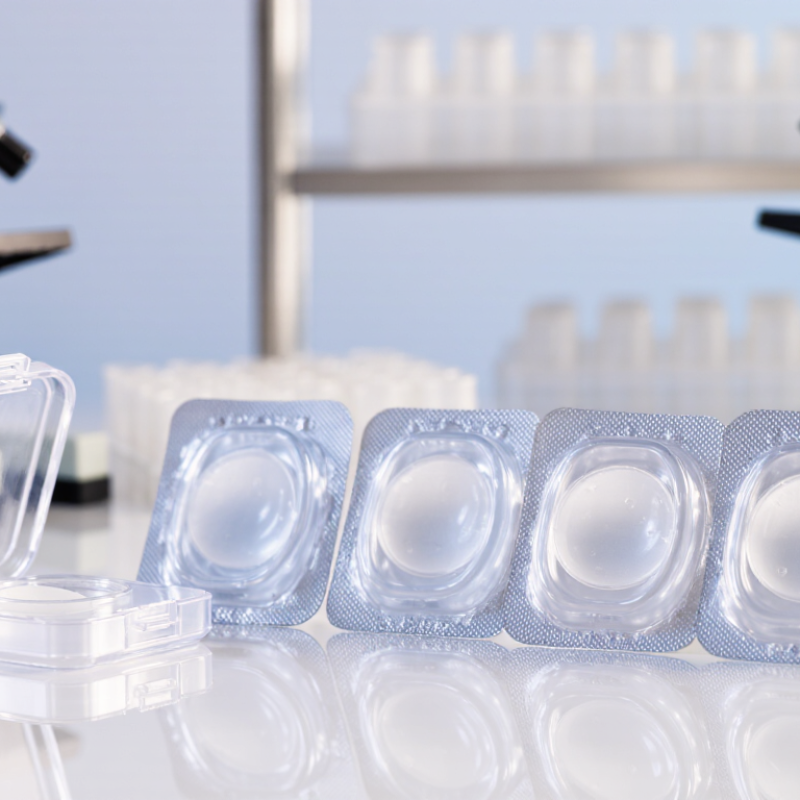
Prescription clear contact lenses are transparent medical devices designed to correct refractive errors, including myopia, hyperopia, and astigmatism. Unlike cosmetic lenses, they use measured optical power from a qualified eye examination. The lens rests on the tear film, helping light focus more accurately on the retina.
The need is substantial. The World Health Organization reported that at least 2.2 billion people have vision impairment worldwide, with unaddressed refractive error among the major causes. In the United States, the Centers for Disease Control and Prevention estimates that about 45 million people wear contact lenses. These figures explain why reliable prescription-lens suppliers matter. Still, market size does not guarantee product quality.
Key features include oxygen permeability, stable fit, moisture retention, edge comfort, and resistance to deposits. Silicone hydrogel materials can support higher oxygen transmission, but performance depends on design and wearing behavior. A comfortable lens may still be unsuitable if worn too long. That detail is often overlooked.
Prescription accuracy is essential.
Suppliers should provide traceable specifications, replacement guidance, usage instructions, and professional fitting support. The International Organization for Standardization also maintains requirements for contact-lens safety and performance, giving buyers a useful quality reference. I would not judge a supplier only by price or packaging. Real evaluation should consider material data, manufacturing consistency, complaint handling, and clinical feedback. Even experienced wearers can misread discomfort as normal adjustment. Redness, pain, or blurred vision requires prompt professional assessment.
Standard nominal replacement intervals for commonly prescribed soft clear contact lenses
Daily disposable lenses are replaced after one day of use, two-week lenses after up to 14 days, and monthly lenses after up to 30 days. Actual replacement timing depends on the product labeling, wearing schedule, eye-care professional guidance, and lens condition.
When evaluating China-based suppliers of prescription clear contact lenses, verify clinical quality before comparing prices. The CDC reports that about 45 million Americans wear contact lenses. Its MMWR survey also found that 99% of users reported at least one risky care behavior. These figures show why material safety, oxygen permeability, and fitting accuracy matter.
Request ISO 18369 test records, prescription-range data, and lot-level certificates. Check whether the supplier controls base curve, diameter, water content, and power consistency. Ask for samples from different production batches. Inspect edge smoothness and packaging seals under real conditions. A clean sample is not enough.
Review manufacturing audits, complaint rates, replacement policies, and traceability procedures. Confirm that labels match regional medical-device rules. The U.S. FDA classifies contact lenses as medical devices, so vague compliance claims deserve caution. Ask how the supplier handles power deviations and damaged packaging. Fast replies help, but documented corrective actions matter more. Price can mislead. I would not trust a supplier using only laboratory samples or copied certificates. The CDC MMWR findings make user safety a practical purchasing benchmark, not a marketing phrase. Performance should remain stable after repeated wear and storage, although supplier claims still need independent verification.
| No. | Evaluation Dimension | What a Qualified Supplier Should Demonstrate | Practical Benchmark for Prescription Clear Contact Lenses | Documents or Data to Request | Suggested Weight |
|---|---|---|---|---|---|
| 1 | Regulatory Authorization | Products are legally manufactured and supplied for the intended destination market. | Valid market-specific clearance, registration, or conformity documentation before commercial shipment. | Registration or clearance number, declaration of conformity, product labeling, and authorized manufacturing-site information. | 15% |
| 2 | Quality Management System | The manufacturing site operates a documented medical-device quality system with traceable procedures. | Current ISO 13485 certification issued for the relevant manufacturing scope is a strong qualification indicator. | Unexpired certificate, certification scope, latest audit status, corrective-action procedure, and change-control process. | 15% |
| 3 | Prescription Parameter Range | The supplier can consistently produce the powers, base curves, diameters, and cylinder or axis options required by the target market. | Confirm the exact available range rather than relying on a general catalog; verify tolerance for every prescription parameter. | Current specification sheet, approved product drawings, tolerance table, and representative inspection reports. | 12% |
| 4 | Material and Oxygen Performance | The lens material and manufacturing process are suitable for the intended wearing schedule and prescription design. | Request measured oxygen permeability and oxygen transmissibility data, with the test method and lens thickness stated clearly. | Material identity, technical data sheet, Dk and Dk/t test results, water-content data, and biocompatibility information. | 12% |
| 5 | Product Safety Testing | Finished lenses are tested for physical, chemical, microbiological, and biological safety as applicable. | Testing should cover dimensional accuracy, optical power, surface quality, extractables, sterility or microbiological control, and biocompatibility. | Finished-product test reports, biological evaluation, sterility validation where applicable, and batch-release criteria. | 12% |
| 6 | Prescription Accuracy and Batch Consistency | Production lots demonstrate stable optical performance and documented traceability from raw material to finished product. | Require lot-specific inspection results and a defined acceptance standard for power, diameter, base curve, cosmetic defects, and packaging integrity. | Certificate of analysis, lot records, sampling plan, calibration records, nonconformance records, and traceability samples. | 12% |
| 7 | Packaging and Shelf Life | Primary packaging protects lens sterility or microbiological quality and preserves product performance throughout the stated shelf life. | Shelf life, storage conditions, lot identification, expiry date, solution compatibility, and package-integrity validation must be documented. | Packaging specification, stability study summary, seal-integrity test, label artwork, storage instructions, and expiry validation. | 8% |
| 8 | Customization and Private Label Capability | The supplier can support compliant packaging, prescription configurations, artwork control, and product changes without losing traceability. | A controlled approval process should exist for artwork, labeling translations, packaging components, and product modifications. | Customization workflow, minimum order quantity, sample approval process, artwork controls, and change-notification policy. | 6% |
| 9 | Supply Capacity and Delivery Reliability | The supplier has sufficient validated capacity and contingency planning for repeat orders and prescription-mix variation. | Evaluate production lead time, monthly capacity, forecast requirements, on-time delivery history, and backup plans for critical materials. | Capacity statement, production schedule, lead-time commitment, delivery records, business-continuity plan, and inventory policy. | 5% |
| 10 | After-Sales and Complaint Handling | The supplier investigates complaints, manages recalls when necessary, and provides timely technical support. | A documented complaint-response procedure should define acknowledgement, investigation, root-cause analysis, corrective action, and closure targets. | Complaint form, response-time standard, CAPA procedure, recall process, adverse-event reporting workflow, and service contact details. | 3% |
China’s Top 10 Prescription Clear Contact Lens Suppliers should be assessed through evidence, not export volume alone. Grand View Research valued the global contact lens market at about USD 10.8 billion in 2023. It also projected steady growth through 2030. China’s expanding optical market supports more private-label and original-equipment manufacturing capacity. Still, supplier quality differs sharply.
A reliable supplier should provide valid NMPA registration, ISO 13485 certification, and traceable batch records. These documents support manufacturing control and post-market accountability. Buyers should also request oxygen-transmission data, water content, base curve ranges, and power availability. The FDA notes that contact lenses are medical devices requiring professional fitting and prescription control. That principle matters during international sourcing, too.
Factory audits can reveal details that brochures hide. Check cleanroom zoning, blister-sealing tests, storage humidity, and complaint-response procedures. Ask for recent test reports, not old certificates. Production scale is useful, but it cannot replace clinical evidence. Some supplier profiles remain incomplete because audited performance data is rarely published. That is a weakness. It deserves careful review.
For China’s top ten prescription clear lens suppliers, compare sample consistency, customization limits, lead times, and regulatory support. A practical trial should examine lens clarity, edge finish, packaging integrity, and power accuracy across several batches. Small differences become uncomfortable after hours of wear. Supplier rankings should therefore remain provisional, especially when independent wearer feedback is limited.
Reliable prescription clear contact lens suppliers should operate under documented quality systems. ISO 13485 certification is an important starting point. It shows that production follows controlled medical device procedures. However, certification alone does not prove consistent lens performance. Buyers should inspect audit dates, certificate scope, and manufacturing locations.
Product quality depends on precise power, base curve, diameter, and water content. Each batch should receive visual inspection and dimensional testing. Oxygen transmissibility also deserves close attention, especially for extended daily wear designs. Packaging must protect sterility and prevent moisture loss. Lot numbers should support quick traceability. Suppliers should provide test reports, declarations of conformity, and suitable biocompatibility evidence, such as ISO 10993 assessments.
Experienced suppliers usually maintain clean production rooms, calibrated instruments, and trained inspection teams. They also record nonconforming products instead of hiding them. That practice builds trust. For overseas buyers, compliance must match the destination market, including applicable registration and labeling rules. A supplier may hold several certificates yet still have weak complaint handling. I would review sample lenses, packaging seals, inspection records, and response times before approving a purchase. No audit is flawless. Questions often reveal more than polished certificates.
Ordering prescription clear contact lenses from China requires clinical accuracy and supplier discipline. Begin with a current prescription from a qualified eye-care professional. Share sphere, cylinder, axis, base curve, diameter, and replacement schedule. Never rely on an old box label. A supplier should confirm specifications before production. Ask for trial samples, material data, sterility records, and batch traceability. These documents make comparisons more practical, not merely persuasive.
Customization may include powers, toric corrections, curves, diameters, packaging language, and private carton design. Confirm which changes require new tooling or additional testing. Request written sample approval procedures and a realistic production timeline. I have found that attractive samples can hide uncomfortable edge designs. Wear evaluation matters. Ask how the supplier handles defects, prescription errors, damaged cartons, and delayed shipments. Their answers reveal operational maturity.
Pricing changes with material, correction range, order volume, packaging, inspection, freight, and payment terms. Compare landed cost, not only unit price. Small trial orders often cost more per lens, but they reduce avoidable risk. Check factory qualifications, quality-system evidence, export experience, and communication records. A capable supplier explains limitations clearly. That is reassuring. Still, online claims are not proof. I would verify certificates independently and involve a licensed professional before market release. My own mistake was treating fast replies as quality evidence; response speed cannot replace testing, traceability, or consistent batch performance.
They are transparent medical devices that correct refractive errors. Their optical power comes from a qualified eye examination. Not a fashion accessory.
They can correct myopia, hyperopia, and astigmatism. Astigmatism may require a toric design. A professional should confirm the correction.
Provide sphere, cylinder, axis, base curve, diameter, and replacement schedule. Use a current prescription. An old box label may be wrong.
Important features include oxygen permeability, stable fit, moisture retention, edge comfort, and deposit resistance. Higher oxygen transmission does not guarantee safe wear. Wearing behavior still matters.
Request material data, trial samples, sterility records, and batch traceability. Check manufacturing consistency and complaint handling. Fast replies prove little.
Options may include prescription powers, toric corrections, curves, diameters, and packaging language. Ask whether changes require new tooling or extra testing. Approve samples in writing.
Compare landed cost, not only the unit price. Consider materials, order volume, packaging, inspection, freight, and payment terms. Cheap can become expensive.
Redness, pain, or blurred vision requires prompt professional assessment. Remove the lenses and seek qualified eye-care guidance. Do not dismiss it.
Small trial orders can reveal fit, comfort, packaging, and batch consistency. They may cost more per lens. That trade-off reduces avoidable risk.
This guide provides a practical overview of Prescription Clear Contact Lenses, including their definition, common uses, material options, comfort, vision correction, and daily care requirements. It explains how these lenses can support users with different prescriptions while emphasizing the importance of proper fitting, accurate parameters, breathability, moisture retention, and reliable after-sales service. Readers will also learn how to evaluate suppliers based on manufacturing capabilities, product consistency, customization options, communication, production capacity, and delivery performance.
The article presents a structured review of China’s top 10 Prescription Clear Contact Lens suppliers without focusing on brand promotion. It highlights the importance of recognized manufacturing standards, quality-control procedures, certification compliance, and traceable production processes. In addition, it covers ordering methods, sample evaluation, prescription customization, minimum order quantities, pricing factors, packaging, and shipment planning. These insights can help distributors, retailers, and professional buyers compare suppliers effectively and select a dependable partner according to product quality, budget, and long-term business needs.